
Description
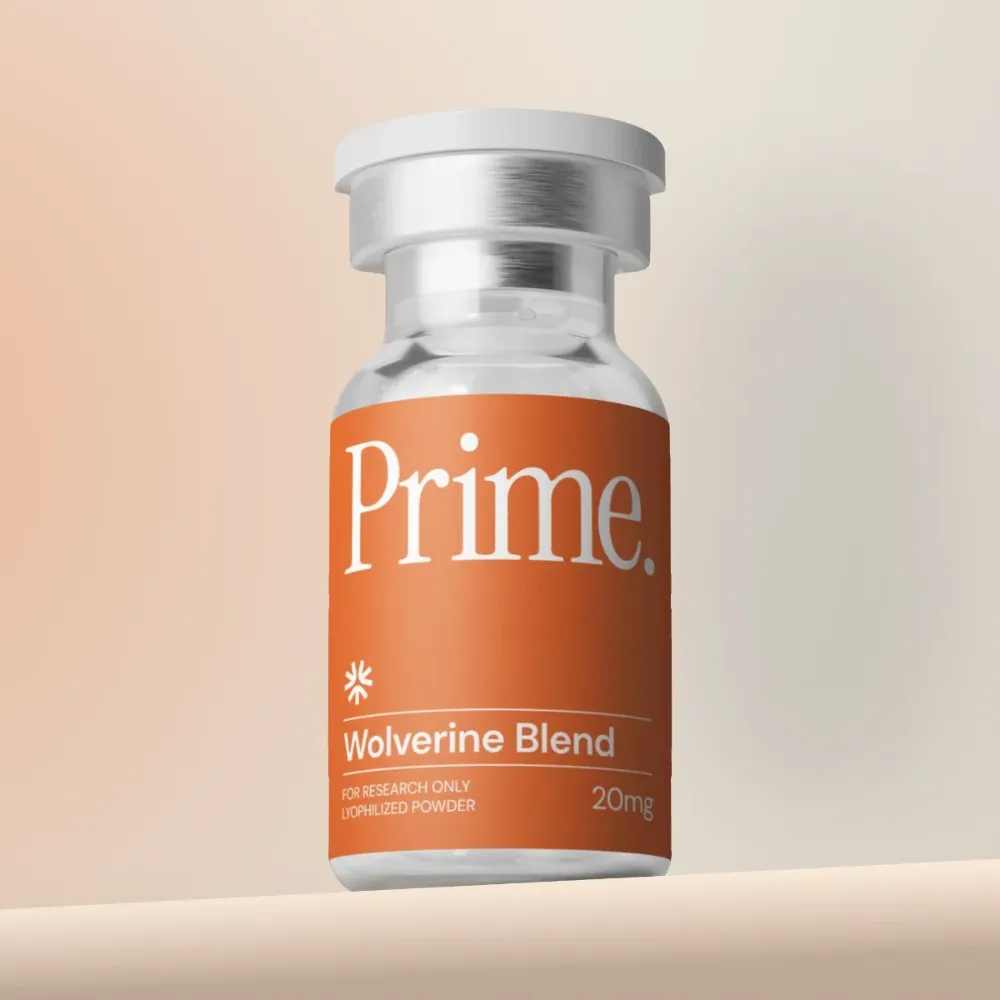
Each Wolverine peptide blend vial at Prime Peptides holds 10mg of BPC-157 and 10mg of TB-500, freeze-dried together for 20mg altogether. It’s intended for lab and analytical work only.
The peptides in the Wolverine peptide blend
BPC-157 is a 15-amino-acid peptide based on a fragment of body protection compound, a protein first found in gastric juice. It’s one of the most widely studied research peptides, almost entirely in rodents.
TB-500: Thymosin beta-4 is a 43-amino-acid protein found in nearly every cell, where it binds actin and helps control cell movement. TB-500 is the name used for synthetic thymosin beta-4 and for a short fragment of its active region.
Wolverine is the name the research community gave to the BPC-157 and TB-500 pair. The two are the most studied repair peptides and act on different stages of healing: BPC-157 is linked to new blood vessel growth and nitric oxide signaling, while thymosin beta-4 binds actin and helps cells move into damaged tissue.
Because the compounds are freeze-dried together, every draw from the vial carries the same ratio.
How the Wolverine peptide blend works
Nobody has pinned down a single receptor for BPC-157. Lab studies point to several pathways: it raises VEGF receptor expression, which feeds blood vessel growth, it interacts with the nitric oxide system, and it increases growth hormone receptor levels in tendon cells.
Thymosin beta-4’s main job is holding on to G-actin, the building block of the cell’s internal scaffolding. By controlling how much actin is free to polymerize, it controls how cells move and change shape.
Wolverine peptide blend specifications
- BPC-157: CAS 137525-51-0, C62H98N16O22, 1,419.5 g/mol
- TB-500 (synthetic thymosin beta-4): CAS 77591-33-4, C212H350N56O78S, 4,963.4 g/mol
- Amount: 10mg/10mg (20mg total)
- Form: lyophilized (freeze-dried) powder
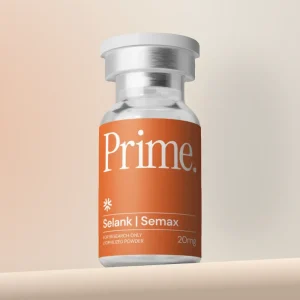
- Label: Prime, For Research Only, Lyophilized Powder
- SKU: PRIME-WOLV-20
- Intended use: laboratory research only
Published studies on Wolverine peptide
Most of the work comes from Predrag Sikiric’s group at the University of Zagreb. Their rodent studies report faster healing of tendon, ligament, muscle and gut injuries, and Mikus and colleagues described improved burn wound healing in mice.
Chang and colleagues reported in 2011 that BPC-157 raised growth hormone receptor expression in rat tendon fibroblasts. Controlled human data are very limited.
Goldstein and colleagues reviewed thymosin beta-4’s role in wound repair in 2012, covering faster closure of skin wounds and new blood vessel growth in animal models.
Bock-Marquette and colleagues reported in Nature (2004) that thymosin beta-4 improved heart cell survival after injury in mice.
Every study mentioned here is indexed on PubMed, the free database run by the NIH. Try this BPC-157 and TB-500 search.
Wolverine peptide blend quality and verification
On the Prime vial you’ll see the compound name, the words “Lyophilized Powder” and a research-only notice. File the order confirmation with your notes so each vial can be traced to its delivery.
Labs that verify incoming material usually run two checks. HPLC gives a purity percentage, and mass spectrometry confirms identity by molecular weight. Either one alone leaves a gap.
Write the order number and the date opened on every vial. If a result looks unusual later, you can trace it back to one delivery.
Wolverine peptide blend mixing guide
There are 20mg of freeze-dried powder in the vial. Divide that by the volume of diluent you add and you have the concentration. For example:
- 1mL of diluent gives 20mg per mL
- 2mL of diluent gives 10mg per mL
- 3mL of diluent gives 6.667mg per mL
Aim the needle at the glass wall, not the powder, and add the liquid slowly. A gentle swirl does the rest. If a thin film remains, a few minutes in the fridge and another swirl usually clears it. Most labs use our bacteriostatic water.
Storing Wolverine peptide blend
Dry, sealed Wolverine peptide blend copes with a few days at room temperature while it ships. For anything longer, keep it in the freezer at -20°C, in the box and away from light. Once mixed, store it at 2 to 8°C and use it within about four weeks.
Keep mixed vials upright so the liquid doesn’t sit against the stopper.
Related to Wolverine peptide blend
- Glow Blend 70mg (GHK-Cu, BPC-157, TB-500), with GHK-Cu, BPC-157 and TB-500 in a single vial
- BPC-157 10mg, a 15-amino-acid peptide
- TB-500 10mg (Thymosin Beta-4), a thymosin beta-4 peptide
- Klow Blend 80mg (GHK-Cu, BPC-157, TB-500, KPV), with GHK-Cu, BPC-157, TB-500 and KPV in a single vial
- CJC-1295 and Ipamorelin Blend 10mg, with CJC-1295 and Ipamorelin in a single vial
Want to see everything? Open our healing and recovery peptides, or start over from the Prime Peptides home page.
Wolverine peptide blend questions and answers
What’s in the Wolverine peptide blend vial?
BPC-157 and TB-500, 10mg/10mg in total.
Can Wolverine peptide be used in people or animals?
No. Prime Peptides sells it for laboratory research only. It isn’t approved for human or veterinary use.
Is Wolverine peptide blend in stock?
Yes, it’s in stock now, and shipping is free.
Where can I buy Wolverine peptide blend?
Right here at Prime Peptide Store. Add it to your cart on this page and check out. Shipping is free on every order.
Is there a discount on Wolverine peptide blend?
Yes. Pay with crypto at checkout and you get 15% off your order.
Get Wolverine peptide blend from Prime Peptides
Ready to order? This blend costs $125.00, it’s in stock and shipping is free. Paying in crypto takes 15% off.
More options for this research area are in our healing and recovery peptides.
Prime Peptides sells this product for in-vitro and laboratory research only. It isn’t a medicine, food or dietary supplement, and it can’t be given to people or animals. The FDA has not evaluated any statement on this page. Buyers must be 21 or older and qualified to handle research chemicals.
Reviews
There are no reviews yet.