

Description
Glow peptide blend from Prime Peptides combines 50mg of GHK-Cu, 10mg of BPC-157 and 10mg of TB-500 in one sealed vial, 70mg in total, so you reconstitute once instead of three times. It’s sold for laboratory research only.
What’s inside the Glow peptide blend
GHK-Cu is the tripeptide glycyl-L-histidyl-L-lysine bound to a copper(II) ion. Loren Pickart first isolated GHK from human plasma in 1973, and levels in plasma are reported to fall with age.
BPC-157 is a 15-amino-acid peptide based on a fragment of body protection compound, a protein first found in gastric juice. It’s one of the most widely studied research peptides, almost entirely in rodents.
TB-500: Thymosin beta-4 is a 43-amino-acid protein found in nearly every cell, where it binds actin and helps control cell movement. TB-500 is the name used for synthetic thymosin beta-4 and for a short fragment of its active region.
Glow pairs the copper peptide GHK-Cu, tied to collagen and tissue remodeling, with the repair pair BPC-157 and TB-500. That covers blood vessel growth, cell migration and matrix rebuilding in one vial, so the blend shows up mostly in skin and wound models.
The peptides are dried together in one vial, so the ratio stays fixed in every draw you take.
How the Glow peptide blend works
GHK binds copper tightly and can deliver it to cells. Copper is a cofactor for lysyl oxidase, the enzyme that cross-links collagen and elastin, and for antioxidant enzymes.
Nobody has pinned down a single receptor for BPC-157. Lab studies point to several pathways: it raises VEGF receptor expression, which feeds blood vessel growth, it interacts with the nitric oxide system, and it increases growth hormone receptor levels in tendon cells.
Thymosin beta-4’s main job is holding on to G-actin, the building block of the cell’s internal scaffolding. By controlling how much actin is free to polymerize, it controls how cells move and change shape.
Glow peptide blend specifications
- GHK-Cu: CAS 49557-75-7
- BPC-157: CAS 137525-51-0, C62H98N16O22, 1,419.5 g/mol
- TB-500 (synthetic thymosin beta-4): CAS 77591-33-4, C212H350N56O78S, 4,963.4 g/mol
- Amount: 50mg/10mg/10mg (70mg total)
- Form: lyophilized (freeze-dried) powder
- Label: Prime, For Research Only, Lyophilized Powder
- SKU: PRIME-GLOW-70
- Intended use: laboratory research only
What the literature says about Glow peptide
Maquart and colleagues reported in 1988 that GHK-Cu stimulated collagen synthesis in cultured fibroblasts, and later rat wound-chamber studies found more collagen and glycosaminoglycan buildup.
Most of the work comes from Predrag Sikiric’s group at the University of Zagreb. Their rodent studies report faster healing of tendon, ligament, muscle and gut injuries, and Mikus and colleagues described improved burn wound healing in mice.
Goldstein and colleagues reviewed thymosin beta-4’s role in wound repair in 2012, covering faster closure of skin wounds and new blood vessel growth in animal models.
Every study mentioned here is indexed on PubMed, the free database run by the NIH. Try this GHK-Cu, BPC-157 and TB-500 search.
How to verify a Glow peptide blend vial
Each Glow peptide blend vial arrives with the Prime label, which names the compound and marks it as lyophilized powder for research only. Your order confirmation lists every vial, which makes it easy to match vials to the study they belong to.
If your lab wants independent confirmation, two tests answer different questions. HPLC shows what share of the sample is the main compound, and mass spectrometry confirms that compound has the expected molecular weight.
Keep one study on vials from one order where you can, and log the order number with your data. It removes one variable.
Glow peptide blend mixing guide
Start from the 70mg in the vial and pick a volume. These are the concentrations you get:
- 2mL of diluent gives 35mg per mL
- 3mL of diluent gives 23.333mg per mL
- 5mL of diluent gives 14mg per mL
Clean the rubber stopper, add diluent a little at a time along the side of the vial and roll it between your fingers until it clears. Never shake it. Add bacteriostatic water to the same order so you have it ready.
Storing Glow peptide blend
Unopened Glow peptide blend keeps best at -20°C. A fridge is fine if you’ll use it soon. After reconstitution it belongs at 2 to 8°C, and most protocols use it up within 28 days.
Let a frozen vial warm up before opening it, since cold glass pulls moisture out of the air.
Related to Glow peptide blend
- Glutathione 1500mg, an antioxidant tripeptide
- Melanotan 2 10mg (MT-2), a melanocortin agonist
- GHK-Cu Copper Peptide 100mg, a copper peptide
- Klow Blend 80mg (GHK-Cu, BPC-157, TB-500, KPV), with GHK-Cu, BPC-157, TB-500 and KPV in a single vial
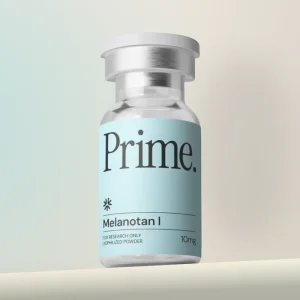
- Melanotan 1 10mg (MT-1), an alpha-MSH analog
Browse the complete list in our skin and tanning peptides and healing and recovery peptides, or head back to the Prime Peptides home page to see every category.
Glow peptide blend questions and answers
What’s in the Glow peptide blend vial?
GHK-Cu, BPC-157 and TB-500, 50mg/10mg/10mg in total.
What do I mix Glow peptide blend with?
Most labs use our bacteriostatic water. The mixing guide on this page lists the strength you get from each volume.
How should Glow peptide blend be stored?
Freeze the sealed vial at -20°C. After mixing, move it to the fridge at 2 to 8°C and finish it inside roughly 28 days.
Can Glow peptide be used in people or animals?
No. Prime Peptides sells it for laboratory research only. It isn’t approved for human or veterinary use.
Is Glow peptide blend in stock?
Yes, this blend is in stock today.
Buy Glow peptide blend at Prime Peptides
Ready to order? This blend costs $130.00, it’s in stock and shipping is free. Paying in crypto takes 15% off.
Building a bigger order? See our skin and tanning peptides and healing and recovery peptides.
Prime Peptides sells this product for in-vitro and laboratory research only. It isn’t a medicine, food or dietary supplement, and it can’t be given to people or animals. The FDA has not evaluated any statement on this page. Buyers must be 21 or older and qualified to handle research chemicals.
Reviews
There are no reviews yet.